
Table of Contents
- What Outsourced Network Management Actually Covers
- In-House vs Outsourced Network Management Cost Comparison
- The Hybrid Model: Splitting Coverage Between Internal Staff and a Provider
- Cybersecurity Risks of Unmanaged Network Systems
- Network Management Outsourcing Best Practices
- Transition and Onboarding Risks Nobody Warns You About
- Conclusion
- Frequently Asked Questions
Last Updated: October 2, 2026
What Outsourced Network Management Actually Covers
For IT leaders weighing whether is outsourced network management worth the cost, the honest answer starts with what you’re actually buying. Outsourced network management is the practice of handing day-to-day monitoring, maintenance, and security of your network infrastructure to a third-party provider under a service level agreement. At Systems Integrations, we’ve watched businesses wrestle with this decision, and the ones who get it right start by mapping exactly what a managed contract includes before they compare a single invoice.
The Core Services Inside a Managed Network Contract
A managed service provider typically takes on several recurring duties:
- Proactive monitoring of switches, routers, and access points
- Patch management and firmware updates across your hardware lifecycle
- Incident response and remote troubleshooting
- Bandwidth management and network performance tuning
- Real-time alerts routed to a network operations center
- Vendor management for carrier circuits and hardware warranties
Where the Line Sits Between Managed Services and Physical Security
This is where most guides get vague. Network management covers the connectivity layer. Physical security covers the devices riding on it: cameras, card readers, intrusion sensors. When those systems share your network, the two disciplines collide. A camera with outdated firmware is a network risk, not just a security gap. That overlap is exactly where a cybercentric integrator earns its keep.
In-House vs Outsourced Network Management Cost Comparison
The in-house vs outsourced network management cost comparison rarely comes down to salary alone. A single network engineer carries salary, benefits, training, and tooling. That’s your capital expenditure and operational expenditure in one line. An outsourced contract folds those into a predictable monthly fee, but adds a vendor relationship to manage.
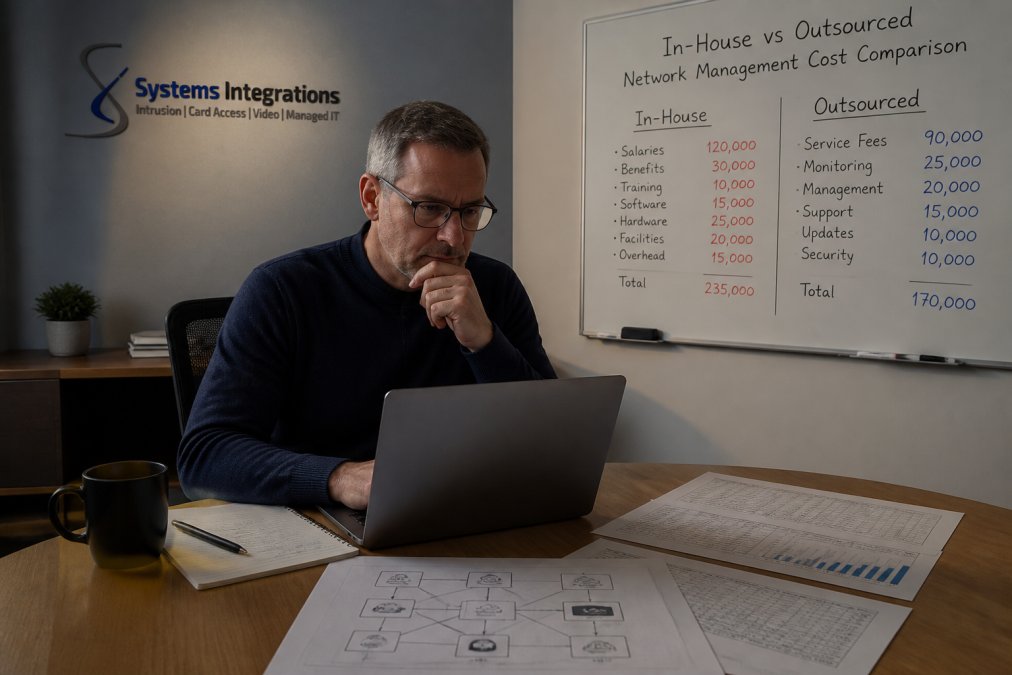
Here’s the comparison most budget meetings miss:
| Cost Category | In-House | Outsourced |
|---|---|---|
| Staffing | Salary, benefits, training | Included in monthly fee |
| Coverage hours | Business hours unless you staff shifts | Often 24/7 |
| Tooling | You buy and maintain it | Provider supplies it |
| Turnover risk | You absorb the gap | Provider absorbs it |
| Expertise depth | Limited to your hires | Pool of certified professionals |
The Costs That Never Show Up on an In-House Budget Line
Technical debt accumulates quietly. So does the cost of a single engineer becoming a single point of failure. When that person leaves, you’re not just hiring a replacement. You’re rebuilding institutional knowledge about your own network architecture. Many businesses find that hidden cost outweighs the visible savings of keeping everything internal.
A Total Cost of Ownership Framework You Can Actually Run
Most articles stop at the table above. That’s a mistake, because the table hides the line items that decide the outcome. Build your own total cost of ownership (TCO) model by pricing each of the following for a 12-month horizon, then compare the sum against your quoted managed contract:
In-house cost inputs
- Fully loaded compensation for every network role, including payroll taxes, health coverage, retirement match, and bonus
- Recruiting and onboarding cost per hire, amortized across expected tenure
- Training, certification, and conference budget per engineer per year
- Monitoring, ticketing, configuration management, and backup tooling, licenses plus the staff hours to run them
- Hardware refresh and spare-parts inventory carried on your books
- After-hours and on-call compensation, or the overtime that replaces it
- Coverage gap cost: what a 2 a.m. outage costs in lost revenue and remediation before your team wakes up
- Turnover cost: the recruiting, ramp-up, and knowledge-rebuild expense each time an engineer departs
Outsourced cost inputs
- Recurring monthly or annual service fee
- One-time onboarding and transition cost
- Any per-device, per-site, or per-ticket charges above the base contract
- Internal time to manage the vendor relationship, review reports, and attend quarterly business reviews
- Change-order fees for work outside the defined scope
- Early-termination or data-egress terms if you leave
The comparison that matters
Build the model in a spreadsheet, not a slide. The moment you assign a dollar figure to after-hours coverage and turnover, the decision usually stops being philosophical and starts being arithmetic.
What the Numbers Usually Show
A common pattern is that the visible salary line favors in-house while the fully loaded TCO favors outsourcing once coverage extends past business hours or spans more than one site. The reverse is also common: a single-site organization with a strong internal engineer and modest coverage needs often beats any managed quote on cost. The framework above is what tells you which pattern you’re in, not a vendor’s brochure.
The Hybrid Model: Splitting Coverage Between Internal Staff and a Provider
The hybrid model keeps strategic control in-house while outsourcing the repetitive, around-the-clock work. Your team owns IT strategy and vendor relationships. The provider handles proactive monitoring, patch management, and after-hours incident response.
Where to Draw the Line
The hybrid model only works when the split is deliberate. A useful rule is to assign work by whether it is strategic, relational, or repetitive:
- Keep in-house: architecture decisions, vendor and carrier negotiations, budget ownership, compliance accountability, and anything that requires deep knowledge of how your business actually runs
- Hand to the provider: 24/7 monitoring, alert triage, patch and firmware management, after-hours incident response, and routine performance reporting
- Decide explicitly: change management, hardware lifecycle calls, and security policy enforcement, these are the handoffs that cause the most friction when nobody owns them
Co-Managed IT: The Governance Layer
A co-managed arrangement is a hybrid with a formal governance layer on top. In practice that means a shared ticketing queue, agreed escalation paths, and a single named point of contact on each side. It also means the provider’s tools and your tools have to talk to each other, or you accept that your team will work in two systems.
- A responsibility matrix that names who owns each function, from monitoring to patching to escalation
- A shared escalation path with response-time commitments at each tier
- A recurring review cadence, monthly for incidents, quarterly for performance and cost
The most common hybrid failure is unclear ownership of patch management. Both sides assume the other is doing it, and the gap only surfaces during an audit or an incident. Put it in writing.
How Hybrid Pricing Usually Works
Hybrid contracts are rarely a flat fee. A common structure is a base monitoring and after-hours fee, plus per-incident or per-device charges for work above the agreed scope, with your internal team absorbing everything inside the boundary. That structure rewards you for keeping strategic work in-house and penalizes you only when you push repetitive work back onto the provider outside the contract.
When Hybrid Beats Both Extremes
Hybrid tends to win when you have real internal capability but not enough of it to cover nights and weekends, when you have compliance obligations that require an internal owner, or when you’re mid-transition and not ready to hand over everything at once. It tends to lose when your internal team is too thin to own the strategic half, because then you’re paying for a provider and still carrying the risk.
The question isn’t in-house or outsourced. It’s which functions belong to each side, who owns the handoffs, and whether the contract prices the split honestly.
Cybersecurity Risks of Unmanaged Network Systems
Unmanaged systems are the quiet entry point in most breach stories. Every device without current firmware, every camera running default credentials, becomes a potential attack path. The cybersecurity risks of unmanaged network systems compound across a multi-site portfolio, where one weak location can expose the rest.
How Unmanaged Devices and Systems Create Attack Paths
A single unpatched device gives an attacker a foothold. From there, lateral movement across a flat network is often trivial. This is why compliance standards like NDAA requirements exist for the hardware government contractors deploy. CISA guidance on securing network infrastructure outlines how unmanaged endpoints undermine an otherwise sound security posture.
Skipping patch management on IP cameras and access controllers is one of the most common mistakes we see. Those devices sit on your network for years, and outdated firmware is a standing invitation for attackers.
Network Management Outsourcing Best Practices
Good outsourcing outcomes come from good contracts, not good intentions. Follow these network management outsourcing best practices before you sign:
- Demand a written service level agreement with response-time commitments
- Confirm who owns hardware lifecycle decisions
- Require documented patch management and incident response procedures
- Verify compliance credentials relevant to your industry
- Establish a single point of contact for escalations
- Plan a quarterly review of network performance metrics
Ask any prospective provider to walk you through their last three incident responses. The quality of that walkthrough tells you more than any sales deck.
Transition and Onboarding Risks Nobody Warns You About
Switching providers is where most of the pain hides. Documentation gaps, mismatched hardware, and unclear ownership of existing configurations can stall a transition for months. A common mistake is treating onboarding as a formality rather than a project with its own timeline and risks.
The real cost of outsourcing isn’t the monthly fee. It’s the transition you didn’t plan for. Budget time and internal resources for onboarding before you sign anything.
Conclusion
Deciding whether outsourced network management is worth the cost comes down to your specific mix of staffing, coverage needs, and compliance requirements. Systems Integrations helps you answer that question with a cybercentric approach built on NDAA-compliant systems, unified security management, and proactive IT support and network management. Our team delivers immediate alerts and rapid emergency response across single-site and multi-location operations.
Frequently Asked Questions
Does outsourcing network management really save money?
It depends on what you count. A managed contract replaces salary, benefits, training, and tooling costs with a predictable monthly fee, which usually looks cheaper on paper. The real savings show up in overhead reduction: fewer emergency callouts, less downtime, and no scramble to hire when a technician leaves. For multi-site organizations, the gap widens because one provider covers every location instead of staffing each one separately.
What are the hidden costs of managing network infrastructure in-house?
The salary line is the visible part. The hidden costs include ongoing training for certifications, monitoring software licenses, spare hardware, and the productivity lost when your team fights fires instead of planning. Technical debt builds quietly when patching and hardware lifecycle work get deferred. Many IT directors also underestimate recruitment costs, since replacing a network engineer in a tight labor market can take months and disrupt projects.
How does outsourced network management impact cybersecurity posture?
A managed provider typically brings proactive monitoring, patch management, and incident response that most internal teams cannot sustain around the clock. That matters for compliance standards like NDAA requirements, where unpatched or unmonitored devices can put contracts at risk. The cybersecurity risks of unmanaged network systems, including unmonitored cameras and access control panels, are reduced when someone is watching real-time alerts and responding to them.
What metrics should measure the ROI of network outsourcing?
Track network uptime against your service level agreement, mean time to incident response, and the number of internal hours redirected to strategic work. Compare your previous twelve months of staffing, tooling, and downtime costs against the contract’s predictable monthly fee. Also watch IT staff turnover and the volume of remote troubleshooting tickets, since both tend to fall when a provider handles tier-one and tier-two issues.