
Table of Contents
- Why Manufacturing Firms Are Outsourcing IT in 2026
- IT Challenges in Manufacturing: Downtime, Legacy Systems, and Technical Debt
- Network Security Services for Manufacturing: Protecting IT and OT
- Cyber-Physical Security Integration: Where Access Control Meets Network Defense
- Industrial Cybersecurity Solutions for NDAA and CMMC Compliance
- Proactive vs. Reactive IT Support: What Manufacturers Actually Get
- How to Choose a Managed IT Provider (and Calculate the ROI)
- Frequently Asked Questions
Last Updated: September 17, 2026
Why Manufacturing Firms Are Outsourcing IT in 2026
Manufacturers across South Jersey are turning to managed IT services for manufacturing firms because plant-floor systems now demand more specialized attention than a generalist IT hire can provide. This guide from Systems Integrations explains what managed IT services for manufacturing firms actually cover, where in-house support breaks down, and how to evaluate a provider without getting locked into a contract you regret.
The shift is straightforward economics. A single production line running legacy controls, a cloud ERP, and a badge-access system pulls in three different skill sets. Most small and mid-sized plants in Gloucester and Camden counties cannot staff all three.
Where In-House IT Breaks Down on the Plant Floor
A common mistake is assuming the person who fixes laptops can also secure a programmable logic controller. They are different disciplines. Office IT manages user accounts and email. Plant systems manage physical processes, and downtime there stops revenue immediately.
What most guides miss is how often the gap shows up during offboarding. When a floor supervisor leaves, someone has to collect their keys, disable their network login, and remove their badge access. Miss one, and you have an open door. That is the exact failure mode cloud-managed access control eliminates.
IT Challenges in Manufacturing: Downtime, Legacy Systems, and Technical Debt
Three problems account for most manufacturing IT failures: unplanned downtime, aging equipment that no longer receives security patches, and accumulated technical debt from years of quick fixes. Each one compounds the others.
Legacy systems are the hardest to justify replacing because they still work. The risk is not that they fail. It is that they fail at 2 a.m. during a production run, and nobody on staff knows how to bring them back online.
What a Single Hour of Operational Downtime Actually Costs
Downtime cost depends on your line, your shift structure, and your backlog. Rather than quote a generic industry figure, calculate it against your own numbers: lost units per hour, labor still on the clock, and expedited shipping to recover the schedule. Most plant managers who run this calculation find the number uncomfortable.
That discomfort is useful. It reframes proactive monitoring as a cost-avoidance line item instead of an IT expense.
The strongest argument for proactive support is not faster ticket resolution. It is preventing the outage that never appears on a support log because it never happened.
Network Security Services for Manufacturing: Protecting IT and OT
Network security services for manufacturing must cover two environments that were never designed to talk to each other. IT networks handle business data. Operational technology (OT) networks run the machines. Convergence is now unavoidable, and it is where most risk lives.
The CISA guidance on securing operational technology is blunt about the problem: OT systems were built for availability and safety, not for defense against network intrusion. Patching them is slow because stopping a line to apply an update costs money.
A practical approach separates the two networks with a firewall and controlled data flows, then monitors both from a single view.
Supply Chain Cybersecurity: The Attack Surface You Don’t Control
Your vendors connect to your systems. Your ERP talks to suppliers. Your building management platform may reach outside your walls. Every one of those connections is an entry point you did not build and cannot fully audit.
Cyber-Physical Security Integration: Where Access Control Meets Network Defense
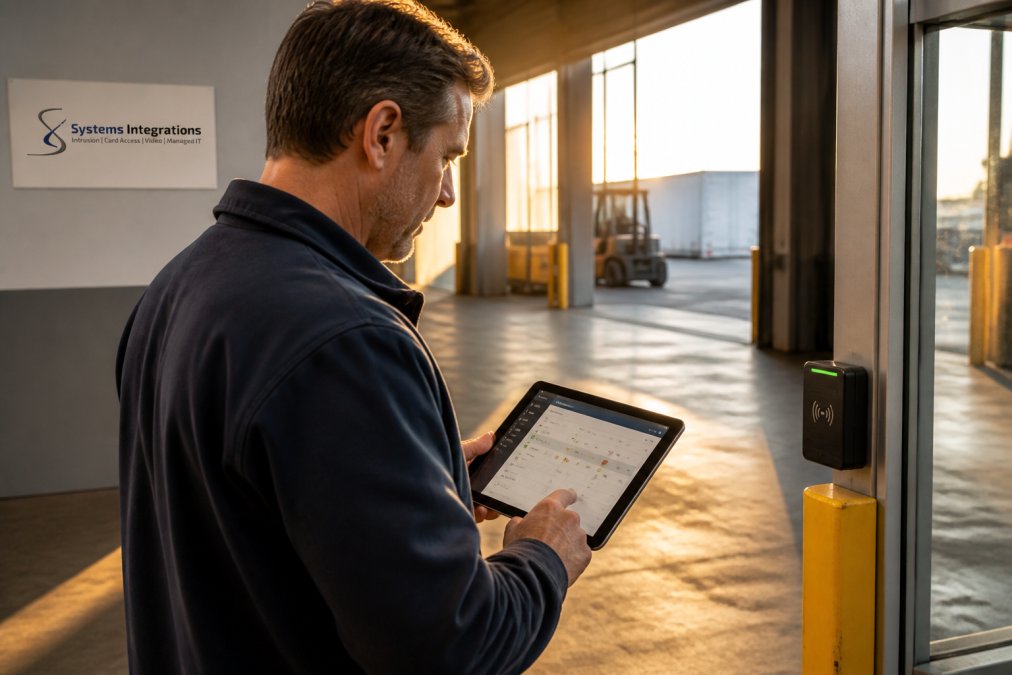
Cyber-physical security integration is the practice of running physical security devices, cameras, badge readers, and intrusion sensors, on the same hardened network foundation as your business systems. When those two worlds stay separate, a compromised camera becomes a doorway into production.
Industrial Cybersecurity Solutions for NDAA and CMMC Compliance
Industrial cybersecurity solutions for manufacturers with government contracts start with hardware provenance. The National Defense Authorization Act restricts certain covered foreign-manufactured video surveillance equipment from federal use, and CMMC adds assessment requirements for contractors handling controlled unclassified information.
| Requirement | What It Covers | Practical Impact on a Plant |
|---|---|---|
| NDAA Section 889 | Bans covered foreign-made surveillance gear | Cameras and recorders must be sourced from approved manufacturers |
| CMMC Level 2 | Protects controlled unclassified information | Access logs, network segmentation, and incident response documented |
| Data retention policy | Governs how long footage and logs are kept | Storage and deletion schedules set per contract |
Proactive vs. Reactive IT Support: What Manufacturers Actually Get
Reactive support waits for a ticket. Proactive support watches the network, patches on a schedule, and replaces failing hardware before it takes a line down. The difference shows up in your uptime numbers, not your invoice.
What Proactive Monitoring Actually Watches
Remote monitoring and management (RMM) tools poll endpoints and network gear on a fixed interval and alert on thresholds before they become failures. In a manufacturing environment, that means watching:
- Disk capacity and drive health on servers running ERP, MES, and file shares, so a failing drive is swapped before it corrupts a production schedule.
- Switch and access-point temperature, power, and port errors, because a switch running hot in an unconditioned rack near the loading dock is a common cause of mid-shift outages.
- Backup job success and restore verification, not just backup completion.
- Patch status on office IT, with a separate, slower cadence for OT devices that cannot tolerate an unplanned reboot.
Backup and Disaster Recovery Built for Production
Backup solutions run nightly and get tested quarterly, because an untested backup is a hope, not a plan. Disaster recovery planning turns that hope into a documented procedure with a recovery time objective (RTO) and recovery point objective (RPO) written into the agreement.
Skipping backup restore tests is the most common and most expensive oversight. A backup that has never been restored is unverified, and discovering that during an outage doubles your downtime.
The OT/IT Convergence Angle Most Providers Miss
Operational technology and information technology were built for different priorities. IT is designed around confidentiality and access control. OT is designed around availability and safety, which is why so many plant-floor systems still run on legacy operating systems that no longer receive vendor security patches.
How to Choose a Managed IT Provider (and Calculate the ROI)
Evaluate providers on four things: response time commitments, whether they understand OT as well as IT, how they handle multi-site access control, and whether they will put service levels in writing. A provider who cannot explain the difference between your ERP and your MES is not ready for a manufacturing account.
ERP and MES: The Backbone Most Providers Ignore
Enterprise Resource Planning (ERP) systems run the business side: orders, inventory, purchasing, and accounting. Manufacturing Execution Systems (MES) run the plant side: work orders, machine status, quality data, and traceability. They talk to each other, and when that integration breaks, production and accounting fall out of sync.
A Simple ROI Framework
Rather than quote a generic industry figure, build the number from your own operation. Add up four cost categories over a twelve-month period:
- Unplanned downtime cost. Multiply lost units per hour by your margin per unit, add labor still on the clock during the outage, and add any expedited shipping or overtime needed to recover the schedule.
- Emergency repair and after-hours support spend. Pull the last year of invoices for break-fix work, after-hours callouts, and emergency hardware replacements.
- Fragmented vendor contracts. Total what you pay separately for IT support, alarm monitoring, camera maintenance, and access control administration.
- Administrative time on access management. Estimate the hours your office manager spends issuing keys, collecting badges, and rekeying locks after turnover, then value that time at a loaded hourly rate.
Questions to Ask Before You Sign
- What is your guaranteed response time for a production-down incident, and is it in the contract?
- Do you manage OT networks, or only office IT?
- Can you support the integration between our ERP and MES, and who do you escalate to when a vendor is unresponsive?
- Can you consolidate access control, video, and intrusion under one contract?
- How do you document compliance for NDAA and CMMC audits?
- What happens if a device fails, and who coordinates the replacement?
- Will you provide a written inventory of every device you manage, including make, model, and firmware version?
Ask for that device inventory on day one. Providers who cannot produce it at the start of the relationship rarely produce it on day 400, and without it you cannot plan firmware updates, replacements, or compliance documentation.
Multi-Site and Multi-Door Considerations
If you operate more than one location, or a single site with several exterior and interior doors, ask how the provider handles credentials across sites. A single cloud-managed dashboard should let you grant or revoke access at any door from a phone or web browser, view timestamped entry logs across every door, and set scheduled permissions so doors unlock during business hours and lock down after.
Frequently Asked Questions
What are some examples of managed IT services?
Modern access control systems offer features like real-time access management, instant credential revocation, detailed audit trails, and scheduled/role-based permissions. Systems Integrations provides these enterprise-grade, NDAA-compliant physical security systems, serving as a dedicated single point of contact for your security needs.
How much should managed IT services cost?
Pricing for modern access control systems depends on the number of doors, locations, and specific features required. Systems Integrations does not publish standard pricing as every business environment differs. Contact them directly for a quote tailored to your facility.
How do managed IT services integrate with physical security systems?
Modern access control systems provide unified management for your physical security. This means you can manage badge reader logs and access permissions from a single platform. The benefit is streamlined security management: if an unauthorized entry occurs, you have immediate access to timestamped entry logs. Systems Integrations specializes in providing integrated access control solutions. Learn more about their card access and video surveillance services.
What specific IT challenges do manufacturing firms face today?
Businesses relying on physical keys face challenges such as lost keys, costly rekeying after employee turnover, and the inability to track who accessed what and when. Modern access control systems address these by offering instant credential revocation, detailed audit trails, and the ability to manage access across multiple doors and locations from a single platform.